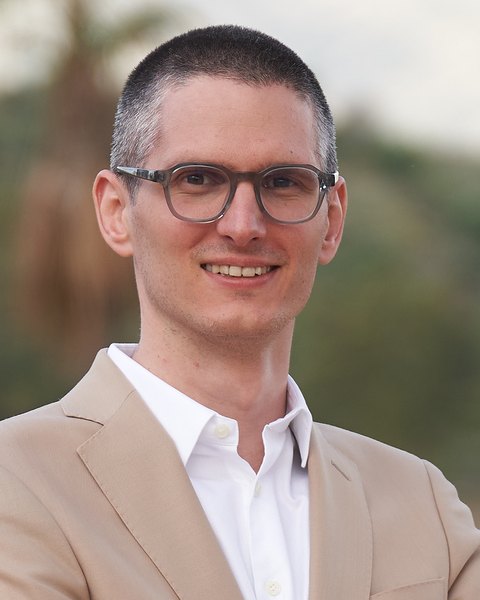
Cell biologist · Medical affairs · Brussels
Hugo Fabre
I lead Medical Affairs for Europe, the Middle East and Africa at Terumo Blood and Cell Technologies.
Before industry I was a cell biologist. I did a PhD in tissue engineering in Lyon, then ran a lab in Basel working on cord blood stem cells for cleft palate surgery.
| Population | Events | % Parent |
|---|---|---|
| All events | 0 | |
| └ Cells | 0 | |
| ├ MNC | 0 | |
| │ ├ Lymphocytes | 0 | |
| │ └ Monocytes | 0 | |
| └ Granulocytes | 0 | |
| └ Your gate | 0 |
Since 2021
Now
I lead the Medical Affairs team for Europe, the Middle East and Africa at Terumo Blood and Cell Technologies. The work sits where medical devices meet clinical practice: therapeutic apheresis, cell collection for transplant and cell therapy, red cell exchange in sickle cell disease, and the evidence that shows what these procedures do for patients.
I joined the company in 2021 as a Medical Science Liaison for cell and gene therapies, cell collection and extracorporeal photopheresis, and took on the regional role in 2023.
Much of my recent writing is about cell collection: how efficient it is, how centres practise it, and how results should be reported so that one centre's numbers mean something to the next.
2007 – today
Path
-
2023 – now
Head of Medical Affairs, EMEA
Terumo Blood and Cell Technologies · Brussels
Regional Medical Affairs across therapeutic apheresis, cell collection, cell and gene therapy and transfusion.
-
2021 – 2022
Medical Science Liaison
Terumo Blood and Cell Technologies
Cell and gene therapies, cell collection and extracorporeal photopheresis.
-
2020 – 2021
Head of Market Development
Firalis · precision diagnostics · Huningue
Brought COVID-19 diagnostic products to European markets during the pandemic, and led the bid that won a US$1M grant from the Alzheimer's Drug Discovery Foundation and Bill Gates Ventures.
-
2015 – 2018
Lab head
Department of Biomedical Engineering, University of Basel
Built a lab inside the newly founded department, working on bone and soft-tissue engineering for cleft palate surgery with infants' own cord blood stem cells. Set up the partnership with the university hospital's cord blood bank and the ethics submissions behind it.
-
2012 – 2015
Doctoral fellow
CTI-Biotech and LBTI (CNRS, Université Lyon 1) · Lyon
Built an in-house flow cytometry core with BD and developed polychromatic panels to characterise and sort stem cells from adult and perinatal tissues.
-
2007 – 2015
PhD in tissue engineering, with honours (2015)
MSc (2012) and BSc (2010) in cell biology and genetics · Université Claude Bernard Lyon 1
Thesis: a flow cytometry screening method to characterise human mesenchymal stem cells from different sources and predict their potential for cartilage reconstruction.
Selected work
Projects
A portfolio in progress. Published work links out. The rest is described at the level I can share: what the work was for and what part I played, not the figures.
-
2026
Reporting standards for cell collections
A systematic review of how mononuclear cell apheresis collections are reported, and expert recommendations for doing it consistently, written with a European group of transplant and apheresis physicians.
-
2026
Leukoreduction, region by region
A systematic review of where blood component leukoreduction is implemented, what guidelines require and what it costs, across regions.
-
2025
Collection efficiency, measured honestly
An analysis of how processed volume changes traditional and crude collection efficiency in stem cell collections, and what that means for comparing centres.
-
2025
A survey of collection practice
A cross-sectional study of cell collection and apheresis practices in collection and transplant centres.
-
Ongoing
Evidence training for field teams
A recurring training series that teaches commercial and clinical colleagues to read a paper, weigh a claim and say plainly what the evidence does not show.
-
Ongoing
Expert engagement across EMEA
Mapping and engaging clinicians in transplant, apheresis and transfusion medicine across Europe, the Middle East and Africa; advisory boards in sickle cell disease and therapeutic apheresis.
-
Ongoing
Evidence for access decisions
Clinical and economic evidence packages that support reimbursement and health technology assessment conversations about apheresis procedures.
-
Ongoing
A personal AI stack for medical affairs
Agents that sweep my inbox and calendar, rerun literature searches, verify citations and build documents from templates, under rules I wrote and keep.
-
2015 – 2018
Cord blood stem cells for cleft palate surgery
A tissue engineering lab set up inside the University of Basel's new biomedical engineering department: cord blood banking with the university hospital, the ethics approvals behind it, and a proof of concept of bone-forming differentiation on allogeneic bone.
-
2012 – 2015
A flow cytometry method for stem cell quality
A screening method to characterise human mesenchymal stem cells from several tissues and predict their potential for cartilage repair, and an in-house cytometry core built with the instrument maker.
-
2020 – 2021
Diagnostics in a pandemic
COVID-19 diagnostic products brought to European markets, and the winning bid for a US$1M Alzheimer's Drug Discovery Foundation and Bill Gates Ventures grant.
Nothing in that area yet.
How I work
AI and automation
A large part of medical affairs is reading, retrieving and reformatting. I have moved that first pass to software: a small personal stack of agents that reads what arrives, keeps the books and drafts. The judgement, and every signature, stays with me.
In
- Mail, calendar and chat
- Meeting notes and recordings
- Literature databases
- Shared document libraries
The stack
- Capture flows in Microsoft 365
- Claude agents run from a terminal
- A plain-text memory with dated snapshots
- Hooks that enforce the rules below
Out
- A register of open commitments
- Drafts waiting for my review
- Reviews, briefs and decks
- Evidence files and search logs
- Inbox and calendar
- A daily sweep of mail, calendar and chat keeps a register of open commitments, writes it into one weekly calendar slot, and drafts the replies I then edit and send.
- Literature
- Published searches rerun on a schedule, deduplicated and screened against frozen criteria, with a log that would survive a reviewer. Every DOI and PMID is checked against its source before a reference enters a document.
- Evidence assets
- One master file of the clinical evidence I work with, keyed by DOI, feeding one-pagers, training material, a searchable browser and a monthly internal newsletter.
- Documents
- Word and PowerPoint built from templates and delivered with tracked changes, comments and a verbatim diff, so a reviewer sees exactly what moved.
- Meetings
- Recordings transcribed on my own hardware; congress reports assembled from hundreds of slide photographs.
- Intelligence
- Competitive, regulatory and policy watch condensed into briefs; market models that show their arithmetic; a prototype dashboard that turns newsletter traffic into structured signals.
- Memory
- A few hundred plain-text notes with dated status snapshots, and a standing rule that the agent re-reads the live source before calling anything current.
Rules I hold the machines to
- Read the whole source. A search locates; it never concludes.
- Nothing is cited from an abstract.
- Every number is traced to where it came from, or it is left out.
- A correction replaces the wrong text. It is never appended underneath.
- Nothing leaves without a person reading it.
The stack is a mix of Microsoft 365 automation and Anthropic's Claude, held together by small scripts and a lot of written rules. If you are building something similar, I am happy to compare notes.
How I run one
Systematic reviews
A systematic review is only as good as its paper trail. Mine are built so that the Methods section can be written from the logs alone, and so that a stranger could rerun every step and land on the same numbers.
Question and protocol
The research questions, the eligibility criteria, the extraction plan and the quality tools are written down first and deposited with a time stamp before the first search runs. Anything that changes later is logged as an amendment, with the reason and the exact wording before and after.
Search
A medical librarian turns each question into a strategy for each database, plus citation chasing and a hand-search of the specialist journals. One execution log holds every line with its date, databases and raw count. Strings are frozen once run; if screening is noisy, the fix is in the screening, never in the string.
Deduplication
Three passes, each logged: exact title and year; exact title with the year off by one; then a fuzzy pass that only flags a pair when a second signal agrees, such as the same first author, journal, or year and page. Flagged pairs go to a person, and those decisions are carried forward when the corpus is rebuilt.
Screening
Title and abstract against the frozen criteria. A language model reads each record and proposes include, exclude or uncertain with a reason code; I make the call. The model is declared in the protocol as a tool, calibrated on a sample before the main pass, and the protocol commits a sample of exclusions to a second reviewer.
Full text and extraction
Every included paper is read in full, never from the abstract, into a fixed extraction table with a definitions sheet, and mapped to the question it answers. Quality is assessed with the tool that fits the design.
Synthesis and reporting
The synthesis is written question by question. The PRISMA flow is compiled from the logs, not from memory, and every DOI and PMID is verified against its source before the reference list is final.
Living surveillance
After publication the search is rerun on a schedule with the string unchanged, so the completeness claim stays defensible and new evidence is caught rather than discovered by a reviewer.
Worked example, in progress
Therapeutic plasma exchange beyond antibody removal: how does it work?
- Research questions
- 7
- Search lines planned
- 24
- Databases, plus citation chasing and three hand-searched journals
- 4
- Records identified, database arm
- 22,500
- Unique records after three deduplication passes
- 16,946
- Near-duplicate pairs judged by a person
- 33
- Priority papers already extracted in full
- 21
- Stage
- screening next
Counts as of 4 October 2026. Protocol time-stamped March 2026, two amendments logged since. Searches by a medical librarian; single reviewer, declared as a limitation.
2014 – 2026
Papers
The early papers come from the bench, on stem cells and tissue engineering. The recent ones come from industry, written with transfusion, apheresis and cell therapy teams.
- 2026
- 2026
- 2025
- 2025
-
2025
Large-Scale Expansion of Suspension Cells in an Automated Hollow-Fiber Perfusion Bioreactor
Bräuchle E, Knaub M, Weigand L, Ehrend E, Manns P, Kremer A, Fabre H, Bonig H
Bioengineering · 12(6):644ArticleDOI PubMed Free full text Correction
-
2021
Perrier-Groult E, Aubert-Foucher E, Pasdeloup M, Lafont J, Fabre H, Mallein-Gerin F
Stem Cells and Regenerative Medicine (IOS Press) · Biomedical and Health Research seriesBook chapterDOI
-
2019
Fabre H, Ducret M, Degoul O, Rodriguez J, Perrier-Groult E, Aubert-Foucher E, Pasdeloup M, Auxenfans C, McGuckin C, Forraz N, Mallein-Gerin F
Stem Cells International · 2019:2186728ArticleFirst authorDOI PubMed Free full text
- 2019
-
2017
Current challenges in human tooth revitalization
Ducret M, Fabre H, Celle A, Mallein-Gerin F, Perrier-Groult E, Alliot-Licht B, Farges JC
Bio-Medical Materials and Engineering · 28(s1):S159–S168ReviewCo-first authorDOI PubMed
-
2017
Rodriguez J, Pratta AS, Abbassi N, Fabre H, Rodriguez F, Debard C, Adobati J, Boucher F, Mallein-Gerin F, Auxenfans C, Damour O, Mojallal A
Stem Cells International · 2017:9289213ArticleDOI PubMed Free full text
-
2016
Ducret M, Fabre H, Degoul O, Atzeni G, McGuckin C, Forraz N, Mallein-Gerin F, Perrier-Groult E, Alliot-Licht B, Farges JC
Frontiers in Physiology · 7:512ArticleCo-first authorDOI PubMed Free full text
-
2016
Ducret M, Fabre H, Degoul O, Atzeni G, McGuckin C, Forraz N, Mallein-Gerin F, Perrier-Groult E, Farges JC
Bulletin du Groupement International pour la Recherche Scientifique en Stomatologie et Odontologie · 53(1):e37ArticlePubMed
-
2015
Ducret M, Fabre H, Degoul O, Atzeni G, McGuckin C, Forraz N, Alliot-Licht B, Mallein-Gerin F, Perrier-Groult E, Farges JC
Frontiers in Physiology · 6:213ArticleCo-first authorDOI PubMed Free full text
-
2015
Production of Human Dental Pulp Cells with a Medicinal Manufacturing Approach
Ducret M, Fabre H, Farges JC, Degoul O, Atzeni G, McGuckin C, Forraz N, Mallein-Gerin F, Perrier-Groult E
Journal of Endodontics · 41(9):1492–1499ArticleCo-first authorDOI PubMed
- 2014
Nothing matches that filter.
Away from work
Off the clock
- In the air
- Private pilot licence
- On foot
- Marathons
- On two wheels
- Motorbikes
- In my hands
- Classical guitar
- On the wrist
- Mechanical watches
- In the kitchen
- Fine cooking
- In my ears
- Romantic-era music and minimal techno
- On the shelf
- Philosophy, politics, technology
Get in touch
Contact
Email is the best way to reach me. I work in English and French.